
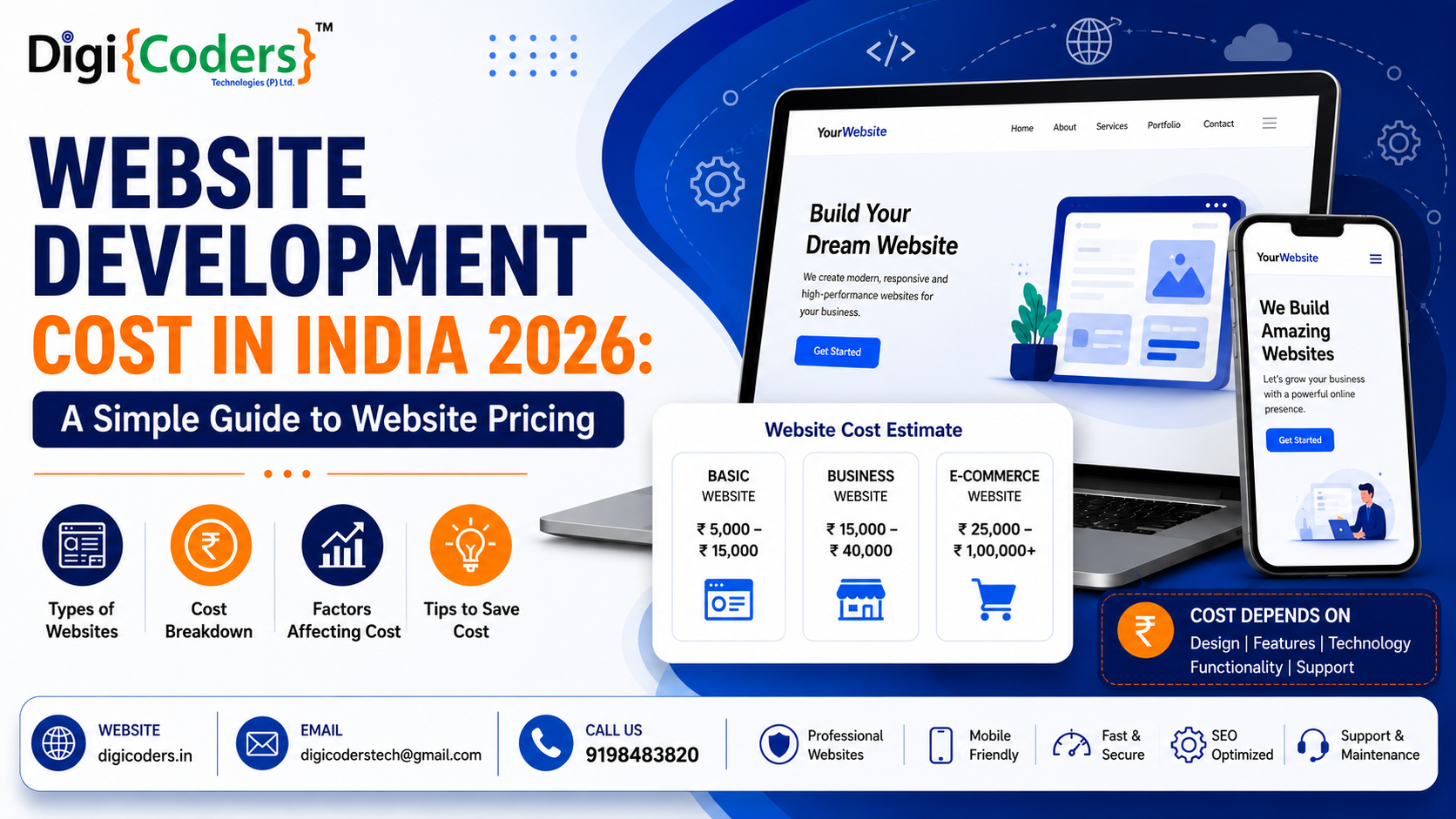
Website Development Cost in India 2026: A Simple Guide to Website Pricing
In today's digital market, a website
can be an important part of a business. It gives customers a place where they
can learn about a company, explore its services, view products, send enquiries,
or make purchases.
But before starting a website
project, most business owners have one common question: How much does it
cost to develop a website in India in 2026?
The answer is different for every
project. A small website for a local business does not require the same amount
of work as an online shopping platform or a custom business application.
The budget depends on the website
type, number of pages, design, features, technology, integrations, development
time, security, and future maintenance.
This guide explains the major
factors that influence website development cost in India 2026 in simple
language so that students, startups, and business owners can understand how
website pricing works.
What
Does Website Development Mean?
Website development is the technical
process of turning a website idea into a working online platform.
It may involve several activities,
including:
- Planning the website
- Designing the interface
- Writing front-end code
- Developing back-end functionality
- Connecting databases
- Adding forms and features
- Setting up security
- Making the website responsive
- Testing different devices
- Connecting third-party services
- Publishing the website
- Providing technical maintenance
The amount of work depends on what
the website is expected to do.
For example, a five-page company
website may need only basic functionality. A booking platform may require user
accounts, calendars, notifications, payments, and an administration system.
Because of these differences,
website pricing cannot be decided by page count alone.
Estimated
Website Development Cost in India in 2026
The following table gives a general
idea of how budgets can vary.
|
Type
of Website |
Approximate
Starting Range |
|
Single Landing Page |
₹5,000
– ₹10,000+ |
|
Basic Business Website |
₹10,000
– ₹20,000+ |
|
ERP |
₹1.Lakh
– ₹2.Lakh+ |
|
E-commerce Website |
₹50,000
– ₹60,000+ |
|
CRM |
₹50,000
– ₹80,000+ |
These are only broad estimates. The
actual quotation can be lower or higher depending on the project's
requirements.
A website with a custom design,
advanced dashboard, multiple integrations, strong security, or special
functionality will generally require a larger investment.
Landing
Page Development Cost
A landing page is a focused web page
designed around one particular goal.
For example, a company may create a
landing page to promote:
- A digital marketing service
- A training course
- A new product
- A special offer
- An upcoming event
- A lead-generation campaign
A landing page usually contains a
short introduction, benefits, images, important information, and a contact or
enquiry option.
Since it has a limited structure, it
can be a practical choice for businesses that want to promote one service
without developing a complete website.
Basic
Business Website Cost
A basic business website is designed
to introduce a company and its services online.
It may contain pages such as:
- Home
- About
- Services
- Portfolio
- Gallery
- Contact
- Blog
This type of website is commonly
suitable for small companies, local businesses, consultants, professionals,
institutes, and service providers.
The budget depends on whether the
business chooses a standard design or asks for a completely customized
interface.
Professional
Business Website Cost
A professional business website
generally requires more planning and customization.
Instead of simply displaying
information, the website can be designed around the company's branding and
customer journey.
Possible features include:
- Custom UI/UX
- Responsive design
- Content management system
- Enquiry forms
- Blog management
- Analytics integration
- Search Console setup
- Technical SEO
- Image optimization
- Speed improvements
- Security configuration
More customization means more
development effort, which can increase the overall project cost.
E-commerce
Website Development Cost
An e-commerce website is designed
for selling products online.
It requires more functionality than
a normal business website because customers need to complete an entire
purchasing process.
An online store may require:
- Product categories
- Product search
- Filters
- Product variations
- Shopping cart
- Checkout
- Online payments
- Customer accounts
- Order tracking
- Inventory control
- Discount coupons
- Shipping integration
- Reviews and ratings
A small online store using an
existing platform may require a moderate budget. A completely customized
shopping platform with thousands of products and advanced business features can
cost considerably more.
Therefore, the size of the product
catalog and the complexity of the shopping system have a major effect on the
final price.
Custom
Web Application Cost
A custom web application is built
for a specific business process rather than simply presenting information.
Examples include:
- CRM systems
- School management software
- Student portals
- Appointment systems
- Employee dashboards
- Customer portals
- Inventory applications
- Learning management platforms
- Booking systems
These projects can become expensive
because developers have to create custom functionality according to the
client's workflow.
The system may also require
different user roles, database operations, notifications, reports, APIs,
authentication, and security controls.
What
Determines Website Development Cost?
Several things can change the final
quotation.
1.
Website Size
A website with ten unique pages
generally requires more design and development work than a small five-page
website.
However, page count is only one
factor. A single page containing complex functionality can sometimes require
more work than several simple pages.
2.
Custom Design
Businesses can choose between a
pre-built design and a customized interface.
A ready-made theme can reduce
development time. A custom design takes more effort because the layout,
components, colours, typography, and user experience are created specifically
for the brand.
3.
Required Features
Features are one of the biggest
factors affecting price.
A basic contact form is relatively
simple. A complete appointment system with customer accounts, payment
collection, automated notifications, and an admin panel requires much more
development.
4.
Technology Selection
Different projects can use different
technologies.
Some common options include:
- WordPress
- WooCommerce
- Shopify
- PHP
- Laravel
- React
- Node.js
- MySQL
The technology should be selected according
to the project's actual requirements instead of choosing a technology only
because it is popular.
5.
Mobile Compatibility
Customers may visit a website from
phones, tablets, laptops, and desktops.
The website therefore needs to adapt
properly to different screen sizes.
Developers have to test menus,
images, buttons, forms, tables, and other components across different devices.
6.
External Integrations
Many websites need to connect with
other platforms.
For example:
- Payment services
- WhatsApp
- Email platforms
- Shipping systems
- CRM software
- Google services
- Social media
- Business APIs
Each external connection needs
configuration and testing, which can affect the development budget.
7.
Security Requirements
Security requirements depend on the
type of information handled by the website.
An informational website may have
simple security needs, while an e-commerce platform or customer portal requires
stronger protection because it handles accounts, orders, personal information,
or transactions.
Extra
Expenses Beyond Development
Many first-time website owners think
the development quotation is the only expense. In reality, some additional
services may have separate charges.
Domain
A domain is the address people type
into their browser to reach a website.
For example, a business may register
a .com, .in, or another suitable domain extension.
The registration fee usually needs
to be renewed periodically.
Hosting
Hosting provides the server
environment where website files and databases are stored.
A small website may work with a
basic hosting plan, whereas a busy website or application may require stronger
server resources.
SSL
and HTTPS
HTTPS helps protect communication
between a website and its visitors.
Many hosting companies provide SSL
as part of their plans, but businesses should confirm what is included before
purchasing hosting.
Premium
Plugins and Themes
Some websites use paid WordPress
themes, plugins, extensions, or other software.
These products may have separate
licensing or renewal charges.
Maintenance
After launch, a website may require
regular attention.
Maintenance can include:
- Updates
- Backups
- Security monitoring
- Bug fixing
- Content changes
- Performance checks
- Technical support
The long-term maintenance cost
should be considered while planning the project.
Freelancer
or Development Company: Which Is Better?
Both options can work, but the right
choice depends on the project.
Freelancer
A freelancer can be suitable when
the project is small and the requirements are straightforward.
Advantages may include direct
communication and comparatively lower development charges.
However, one person may be handling
several responsibilities, so availability and long-term support should be
discussed clearly.
A development company may have
separate professionals for design, coding, testing, SEO, project management,
and support.
This can be useful for businesses
that need a larger website or ongoing technical assistance.
The important thing is not simply
choosing between a freelancer and an agency. The decision should be based on
project complexity, experience, communication, budget, and support.
Why
Choosing the Cheapest Website Can Be a Problem
A very low quotation may look
attractive initially, but businesses should understand exactly what they are
receiving.
Before accepting an offer, ask:
- Is the website custom-designed?
- Is mobile responsiveness included?
- Is hosting included?
- Is the domain included?
- Are security features included?
- Is basic SEO setup included?
- Who owns the website?
- Will the source files be provided?
- Is backup available?
- Is technical support included?
- Are future changes chargeable?
A transparent quotation is much
better than selecting a provider only because the initial price is low.
How
Can You Control Website Development Cost?
A limited budget does not mean that
you cannot create a good website.
You can control expenses by planning
the project properly.
Start
With Essential Features
First build the features that are
necessary for the business.
Advanced functions can be introduced
later when the business actually needs them.
Select
Suitable Technology
Not every business needs a
completely custom application.
For a small company website, a
suitable CMS may be enough. A custom solution makes more sense when the
business requires special functionality.
Prepare
Content Before Development
Providing logos, images, service
information, product details, and other content on time can reduce project
delays.
Avoid
Unnecessary Features
Do not add a feature simply because
another website has it.
Every function should have a clear
purpose and should improve either the customer experience or the business
process.
SEO
and Website Development
SEO should be considered while the
website is being created.
A technically well-planned website
can make future SEO work easier.
Some important areas include:
- Simple website structure
- Descriptive page titles
- Proper headings
- Search-friendly URLs
- Image alt text
- Internal links
- Mobile responsiveness
- Fast loading
- XML sitemap
- Suitable structured data
However, development and ongoing SEO
are not always the same service.
A website can be technically
prepared for search engines, but ranking also depends on content, competition,
backlinks, authority, user experience, and continuous optimization.
How
to Select a Website Development Company
Before choosing a development
company, take some time to understand its work.
Review
Previous Projects
Visit websites developed by the
company.
Check:
- Design quality
- Mobile experience
- Navigation
- Loading speed
- Overall usability
Ask
for a Clear Proposal
A proposal should explain what you
are paying for.
It should ideally mention:
- Pages
- Features
- Technology
- Development timeline
- Total cost
- Payment schedule
- Support
- Maintenance
Discuss
Future Growth
Your website may start small but
become larger later.
Ask whether the selected platform
can handle additional pages, products, users, integrations, and functionality
in the future.
Confirm
Website Ownership
The business owner should understand
who controls the domain, hosting, database, source code, and important
accounts.
This avoids problems if the business
changes its development provider later.
Is
a Website Worth the Investment in 2026?
For many businesses, a website can
be a useful long-term asset.
It can help potential customers:
- Discover the business
- Learn about services
- View products
- Submit enquiries
- Contact the company
- Read useful information
- Make purchases
But simply launching a website does
not guarantee visitors or sales.
A website performs better when it is
supported by useful content, SEO, digital marketing, good design, fast
performance, and regular maintenance.
Frequently
Asked Questions
What
is the website development cost in India in 2026?
There is no fixed amount. A simple
website may be developed for a relatively small budget, while professional
e-commerce websites and custom applications can require several lakh rupees.
The final amount depends on functionality and project scope.
Can
a small business create a website with a limited budget?
Yes. A small business can begin with
a simple website containing essential pages and gradually add advanced features
as the business grows.
Are
domain and hosting included in website development charges?
It depends on the development
package. Some companies include them for a limited period, while others charge
separately.
How
long does it take to develop a website?
A small website may take a few days
or weeks, while a complex e-commerce platform or custom application can take
several weeks or months.
The exact timeline depends on design
approval, content availability, functionality, revisions, and testing.
Does
website development include SEO?
Some companies include basic
technical SEO during development. Complete SEO campaigns involving content,
keyword research, link building, and ongoing optimization may be offered
separately.
Final
Conclusion
The website development cost in
India 2026 is mainly influenced by the type of website you need and the
work required to build it.
A simple landing page can be
affordable, while a professional company website needs more design and
functionality. An online store requires product management, shopping features,
payments, and order handling. Custom web applications require even more
development because they are created around specific business processes.
Instead of asking only for the
cheapest website price, businesses should first identify their goals and
required features.
A clear project scope makes it
easier to compare quotations and avoid unexpected expenses.
The best website is not necessarily
the most expensive one. It is the one that provides the right features, works
well on different devices, protects user information, supports business goals,
and can grow with the company.
Why
Choose The DigiCoders?
If you are planning to create a new
website or improve your existing online presence, The DigiCoders can
help with website design, development, e-commerce solutions, and other digital
requirements.
Before starting development, discuss
your business objectives, required pages, features, technology preferences,
budget, timeline, and future plans with the development team.
Get
in Touch
The DigiCoders


